Home / AI Ranking Factors & Citability
AI Ranking Factors & Citability: What Actually Gets Content Cited
Updated August 25, 2026
Ask ten GEO guides what makes an AI engine cite a page and get ten confident-sounding lists. Ask which of those factors are actually backed by a controlled study, and most of the confidence disappears. Some of it holds up. Some of it is one vendor's 50-site correlation dressed up as a rule.
Key takeaways
- Five factor categories drive most of the citation variance: extraction structure, earned media, freshness, FAQ formatting, and backlinks.
- Content freshness has a real, repeated research signal behind it, though the exact multiplier varies by study.
- FAQ schema's citation boost is genuinely contested: one study found a 3x lift, Ahrefs' larger study found none.
- None of these factors are officially published by any platform; all of them come from independent third-party research.
AI ranking factors are the structural and content signals that influence whether a generative AI engine extracts and cites a page when synthesizing an answer. They fall into five broad categories: extraction structure (how cleanly an engine can lift a standalone answer), earned media and brand mentions, content freshness, FAQ and question-formatted content, and backlinks or domain reputation. Unlike traditional SEO ranking factors, most of these are still being measured independently by third-party research rather than confirmed by the platforms themselves.
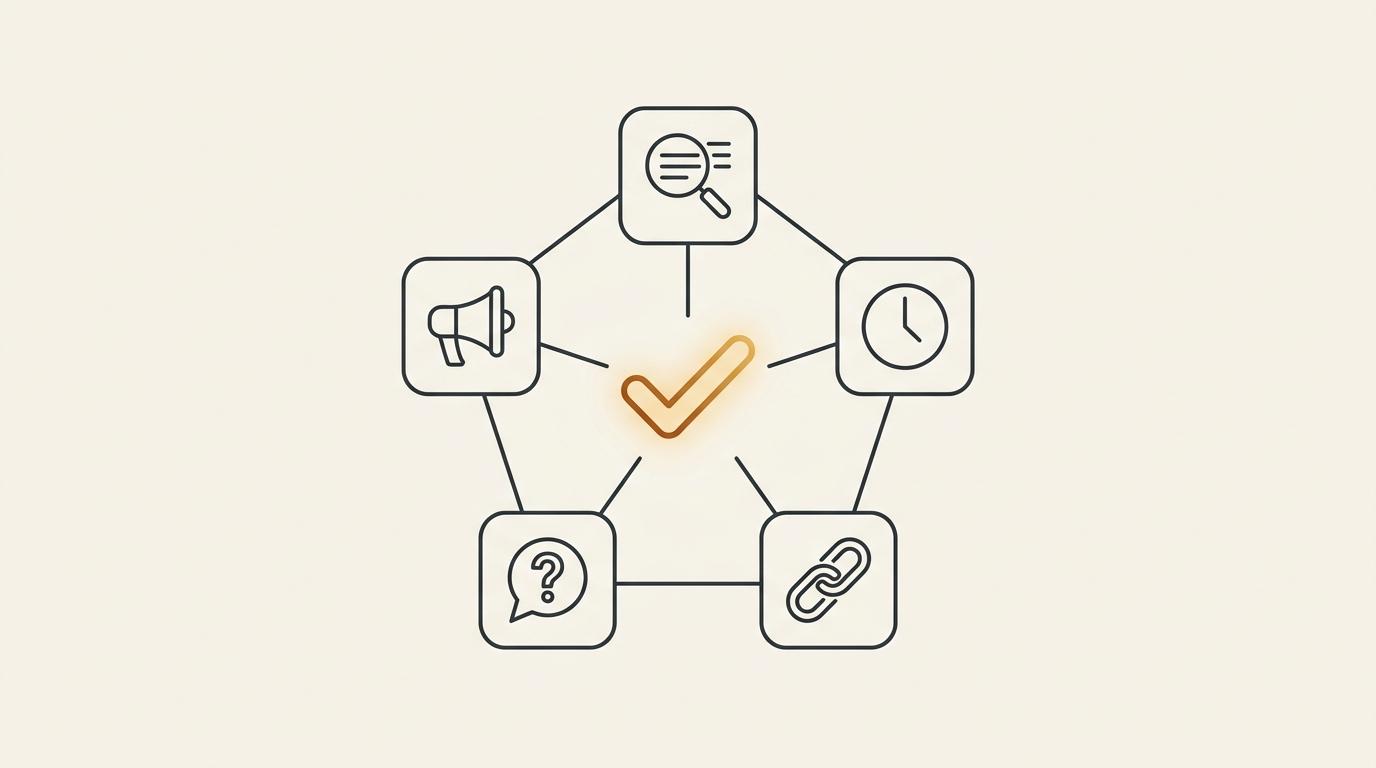
The five ranking factor categories
None of these are published rules any platform has confirmed. They're the categories that show up repeatedly across independent 2026 citation research, in roughly descending order of how much control a business has over them.
| Factor | What it covers |
|---|---|
| Extraction structure | How cleanly an engine can lift a standalone answer: direct claims near the top, real heading hierarchy, defined terms. |
| Earned media & PR | Third-party mentions and press coverage that build the entity recognition AI engines draw on. |
| Freshness | How recently a page was updated, weighted differently across platforms and decaying over time. |
| FAQ formatting | Question-and-answer structured content, with a real, contested research record on its actual effect. |
| Backlinks & brand reputation | Domain-level trust signals that still correlate with citation likelihood, inherited from traditional SEO. |
Does freshness actually matter this much?
Genuinely, yes, more than most GEO advice treats it. Multiple independent 2026 analyses found content updated within the last month earning meaningfully more citations than older pages, on both ChatGPT and Perplexity, with Perplexity appearing to weight recency more heavily of the two.
The exact multiplier moves around by study and methodology, so treat the direction as solid and any single number as a range rather than a guarantee.
~3x
roughly the citation advantage multiple 2026 studies found for content updated in the last 30 days, versus older pages
The FAQ schema controversy
This is the clearest example of the confidence gap in GEO advice generally. Two credible-sounding studies from 2026 landed in completely different places.
Found a real lift
A study reported pages with FAQ schema getting cited roughly 3x more often than pages without it.
Found no lift
Ahrefs' larger, controlled study of 1,885 pages found adding JSON-LD schema produced no measurable citation change.
Both findings can be true at once. The question-and-answer prose itself, not the schema markup wrapped around it, may be doing the work: FAQ-formatted content states a direct answer to a direct question, which is exactly the shape citation research consistently rewards. A correlational study comparing FAQ pages to non-FAQ pages would see that lift. A controlled before-and-after test that only adds schema markup to already-existing prose wouldn't, because the prose shape never changed.
Why this pillar underlies every platform guide
These five factors aren't specific to any one engine. The same extraction-structure and freshness signals that help a page get cited by ChatGPT apply to Perplexity and Google AI Overviews too, since all three are solving a version of the same problem: pull a clean, current, well-supported answer from somewhere. The AI Search Engines & Platforms pillar covers how each platform differs in citation behavior; this pillar covers what stays constant across all of them.
Five things worth reading next
Each factor category gets deeper treatment in its own guide, leading with the flagship reference list.
- The Complete List of AI Ranking Factors (2026) - every factor from this pillar, expanded with the full research behind each one.
- How to Optimize Content for AI Extraction - the structural factor, made actionable.
- Content Freshness and AI Citation Stability - the full freshness research, including how fast citations decay after a page goes stale.
- Earned Media and PR's Role in AI Visibility - why third-party mentions matter for entity recognition, not just backlink value.
- FAQ Sections and AI Citations: Do They Help? - the full version of the controversy summarized above.
Tracking whether your content clears the bar
Knowing the factors is one thing. Knowing whether a specific page actually clears them is another, and that requires scoring the real content against the real signals rather than guessing from a checklist.
Once content is structured well, the next question is whether it's actually getting cited. That's a separate check, covered by the AI Search Engines & Platforms pillar and the free citation checker below.
Score a page against these factors
The free AEO Content Optimizer scores pasted content 0-100 against extraction structure and returns specific fixes, no signup required.
Frequently asked questions
What are AI ranking factors?
The structural and content signals that influence whether an AI engine cites a page: extraction structure, earned media and brand mentions, content freshness, FAQ formatting, and backlinks or domain reputation. They overlap with traditional SEO ranking factors but aren't identical to them, since citation and organic rank are measurably different outcomes.
How do AI engines decide what to cite?
Each platform weighs these signals differently and none has published its exact formula, so the honest answer is assembled from independent third-party research rather than an official specification. Extraction structure (how easily an engine can lift a clean, standalone answer) shows up consistently across studies as the strongest lever within a business's direct control, ahead of external signals like backlinks.
Does content freshness really matter this much for AI citations?
Multiple 2026 analyses found a real freshness bias, with recently updated content earning meaningfully more citations than older pages on both ChatGPT and Perplexity, though the exact multiplier varies by study and methodology. Perplexity in particular appears to weight recency more heavily than ChatGPT does. Treat the direction as solid and the specific number as a range, not a guarantee.
Is the FAQ schema citation boost real?
It's genuinely contested. One 2026 study reported FAQ-schema pages getting cited roughly 3x more often than pages without it. Ahrefs' larger, more controlled study of 1,885 pages found adding schema produced no measurable citation lift. Both can be true at once: FAQ-formatted content (the question-and-answer prose itself) may help independent of whether it's wrapped in schema markup, which would explain why correlational studies see a lift that a before-and-after schema test doesn't.
Do backlinks still matter for AI citations?
They correlate with citation likelihood, largely because backlinks are also a proxy for the domain authority and entity recognition that predate a page even being considered for citation. They're not a lever an individual piece of content controls the way structure and freshness are, which is why this pillar treats them as a background factor rather than a primary optimization target.